Why eLearning tracking is business-critical — more than a tick in a box

When a participant clicks “completed” on an eLearning course, that is really just the start of what administrators and managers should care about. The interesting question is not whether somebody clicked through — but how long they stayed, what they answered, and whether they actually understood the content. Tracking is the only way to distinguish between completed and learned.
In this article, we look at why good tracking is business-critical, what “the big four” means in the SCORM world, and how AlonLearn uses these parameters to deliver real insight — not just empty statistics.
Why does learning need to be documented?
There are three weighty reasons why organisations must be able to document that employees have completed training — and “we think they have” does not hold water in any of them.
Health, safety and the environment. For a range of HSE courses, documentation is a legal requirement. If an incident occurs, or if the Labour Inspection Authority comes for an audit, the business must be able to show in black and white that the right people have completed the right training. Missing tracking can cost both fines and reputation.
Market and customer requirements. More and more clients — particularly in the public sector and in regulated industries — require suppliers to be able to document up-to-date competence among their employees. Tender documents have to contain proof. Without a system that logs completion, score and date, every tender round becomes a manual hunt through spreadsheets.
Certification and authorisations. Many occupational groups must renew their competence regularly in order to retain the right to practise their profession. Tracking is what enables both the individual and the employer to prove that a certificate is still valid.
”The Big Four” — four measurement parameters that actually count
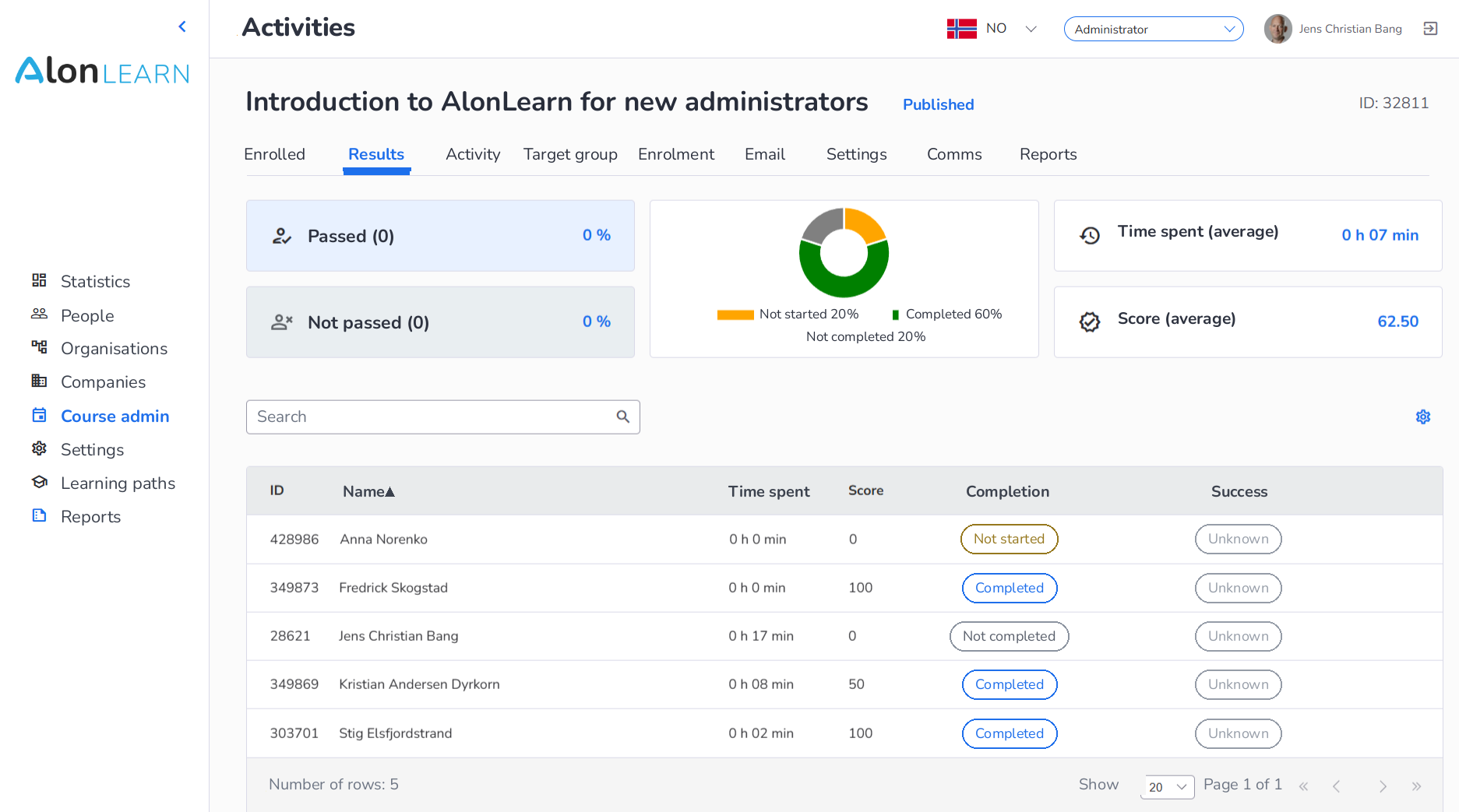
In SCORM-based courses, there are four fundamental parameters that form the backbone of all tracking. Together, they are called “the big four”, and each one tells part of the story:
1. Completion
The simplest parameter — has the participant been through all the content? Modern SCORM players prevent learners from skipping videos or paging past slides, so that the “completed” status actually means that every part has been opened and shown.
But this is exactly where the limit of what “completed” can tell us becomes clear: something being seen does not mean it has been understood. That is why the other three parameters must come along.
2. Time Spent
How long did the participant take? A 30-minute module “completed” in two minutes says it all — there has not been enough time to read, reflect or assess anything at all. AlonLearn logs time spent and makes it available in the analysis tools, so that administrators can spot participants who click through without engagement.
In practice, time spent is one of the most undervalued indicators of real learning.
3. Score
The result on tests and quizzes is logged as a percentage. You can set a minimum percentage to pass, and AlonLearn supports logic that requires the whole course to be retaken if the participant does not reach the threshold.
Score is where learning is measured against concrete goals — and it is the data that HR, managers and auditors often ask for first.
4. Passed / Failed
The final result, based on the score requirements you have set. In AlonLearn, “passed” automatically triggers the issuing of a course certificate — the certificate is immediately available on the participant’s My Page, and can be shared or downloaded as needed.
Failed status, in turn, notifies both the participant and the manager that something needs to be redone — without manual emails or follow-up lists.
When “completed” is not enough
A simple eLearning course where the participant only has to click the right answer to move on opens the door to plain guesswork. The result may look fine in the statistics — everyone has “completed” — without anyone having learned a thing.
That is precisely why the four parameters must be considered together. A completed course with a high score, but unrealistically low time spent, deserves a follow-up question. A low score with a long time may signal that the content is too difficult — or that the learning material needs improvement. The whole picture provides the answer, not individual numbers.
xAPI and CMI5 — when you need more than the basics
For organisations that want to measure culture and behaviour, not just factual knowledge, there are more advanced tracking standards. xAPI and CMI5 let you log practically anything — from the choices a participant makes in a simulation, to whether they answer in line with internal guidelines in an ethics module.
Concrete examples of use:
- An ethics module can trigger a direct alert to the nearest manager if the answer indicates a breach of the company’s rules.
- A participant who scores low on a specific competence requirement can be automatically enrolled on a follow-up course.
- More detailed behavioural data can be used to improve course content over time.
xAPI and CMI5 require a bit more technical infrastructure, but AlonLearn supports both — and works just as seamlessly as it does with standard SCORM.
Tracking is business value, not administration
It is easy to view tracking as an administrative task — something that “has to be done” because someone demands it. But in practice, good tracking is what makes eLearning deliver real value: it documents that learning has happened, provides a basis for improving content, and gives managers the insight to act proactively.
In AlonLearn, you get “the big four” automatically via SCORM Cloud — without extra configuration, without manual logging. The tracking data flows back to AlonLearn in real time, where it becomes course certificates, reports and insight you can actually use.
SCORM Cloud gives AlonLearn the world’s best eLearning engine
Want to know more?
We'll show you AlonLearn or AlonSkills in 15 minutes — tailored to your sector.