eLearning explained: What are authoring tools, LMS, LXP and LRS — and when do you need what?

Authoring tools for eLearning — where the content is created
eLearning starts with content production. An authoring tool is used to develop the actual course modules that the participants will complete.
Traditional authoring tools such as Articulate and Adobe Captivate have long been market leaders. They provide a high degree of control over interaction, structure and design, and are used in many organisations to produce SCORM-based courses.
In recent years, modern AI-driven solutions have also emerged. Courseau is an example of a native AI authoring tool that is built with artificial intelligence as a core premise — not as an add-on. This makes it possible to:
- Generate courses based on existing documents
- Structure content automatically
- Adapt language, level and target audience
- Reduce development time significantly
When the course is finished, it is typically exported as a SCORM, cmi5 or xAPI package, which can be loaded into a learning platform.
If you do not produce eLearning yourself, you do not need an authoring tool. It is only when training is to be developed as a standardised digital module that this becomes relevant.
See how you can go from document to finished course in minutes: Create engaging eLearning courses in minutes.
LMS — administration and delivery of eLearning
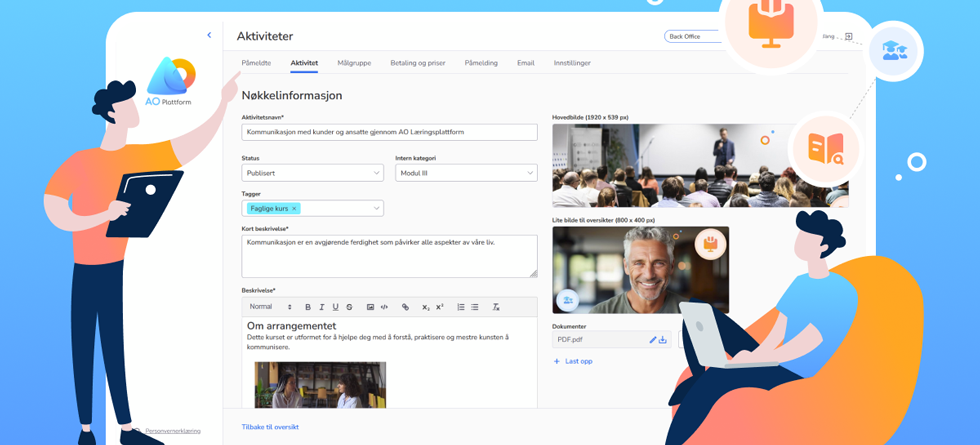
An LMS (Learning Management System) is the platform that administers the training. It handles:
- Creating and publishing courses
- Enrolment and participant administration
- Access control and roles
- Progress reporting
- Documentation of completion
The LMS is not the eLearning itself, but the system that organises and follows it up.
It is also important to understand that an LMS is not used only for eLearning. The platform can administer:
- Physical courses
- Webinars
- Certifications
- Video training
- Blended learning programmes
In many organisations, the LMS also functions as an advanced enrolment system with integrations to HR and finance systems.
LXP — learning experience and personalisation in eLearning
An LXP (Learning Experience Platform) emerged as a supplement to traditional LMS solutions, with a stronger focus on user experience, recommendations and self-directed learning.
In practice, the boundary between LMS and LXP has become less clear. Many modern LMS platforms now include functionality that was previously defined as LXP.
The question for most businesses is therefore not whether they need both an LMS and an LXP, but whether the learning platform supports:
- Good user experience
- Relevant content based on role
- Flexibility in the learning journey
LRS — tracking and learning data in eLearning
When eLearning is developed in an authoring tool and exported as SCORM, cmi5 or xAPI, a system is needed to handle the communication between the course and the platform. This is where the LRS (Learning Record Store) comes in.
The LRS records, among other things:
- Completed / not completed
- Time spent
- Results and scores
- Passed / failed
- Detailed learning activities
The LRS is particularly important in organisations where documentation of competence, certification or regulatory requirements is central.
If you do not use standardised eLearning, a dedicated LRS is often not necessary.
Want to understand why correct tracking can be decisive for your business? Read: Why eLearning tracking is business-critical
**Example: When tracking really matters
**In one concrete case, a serious workplace accident occurred where a skilled worker fell from scaffolding and was severely injured. The incident was reported to the Labour Inspection Authority, and a central question afterwards was whether the injured worker had completed mandatory fall-protection training.
The employer was immediately able to log in to AlonLearn and document that the worker had completed the eLearning course and passed the final test with a defined score requirement.
During the investigation, questions were also raised about whether the worker had understood key parts of the course, particularly relating to the correct use of safety harness and karabiner hooks. Through detailed tracking in SCORM Cloud, the employer was able to go in and see exactly how the relevant questions in the test had been answered, and document that these had been answered correctly.
This kind of documentation is decisive. It ensures that employees receive the right and necessary training — and that the employer can document compliance with requirements and regulations. In cases of personal injury, the consequences can be significant, and missing routines or documentation can have considerable financial and legal repercussions.
For the sake of both employee and employer, we cannot disclose the identity in this case.
How do authoring tools, LMS, LXP and LRS fit together in eLearning?
eLearning can be understood as a coherent process:
- Content is developed in an authoring tool
- The course is published and played back via the LRS
- The LMS/LXP administers participants and reports progress
These components complement each other. The authoring tool creates the learning content. The LRS records what happens. The LMS provides overview and control.
Do you need all of these systems to run eLearning?
Not necessarily.
- If you only run physical courses and webinars, an LMS alone may be sufficient.
- If you produce your own eLearning in SCORM or xAPI, you need both an authoring tool and an LRS.
- If you have requirements for documentation and audit, correct tracking becomes decisive.
- If you are investing in blended learning, the platform must support multiple learning formats.
The most important thing is not to have as many systems as possible, but to have the right architecture for your needs in eLearning.
Summary: The right architecture for eLearning
To succeed with eLearning, you have to understand the difference between:
- Authoring tool — course production
- LMS — administration and delivery
- LXP — learning experience and personalisation
- LRS — tracking and learning data
Together they form a complete eLearning architecture. When you know what each component does — and when you actually need it — it becomes easier to make the right technology choices and build sustainable learning solutions.
Want to know more?
We'll show you AlonLearn or AlonSkills in 15 minutes — tailored to your sector.